

Manure management for dairy operations
Dairy manure systems can include lagoons, storage pits, flush systems, and scrape systems. Treatment rates are based on the number of animals contributing manure to the system and the amount of manure already being stored.
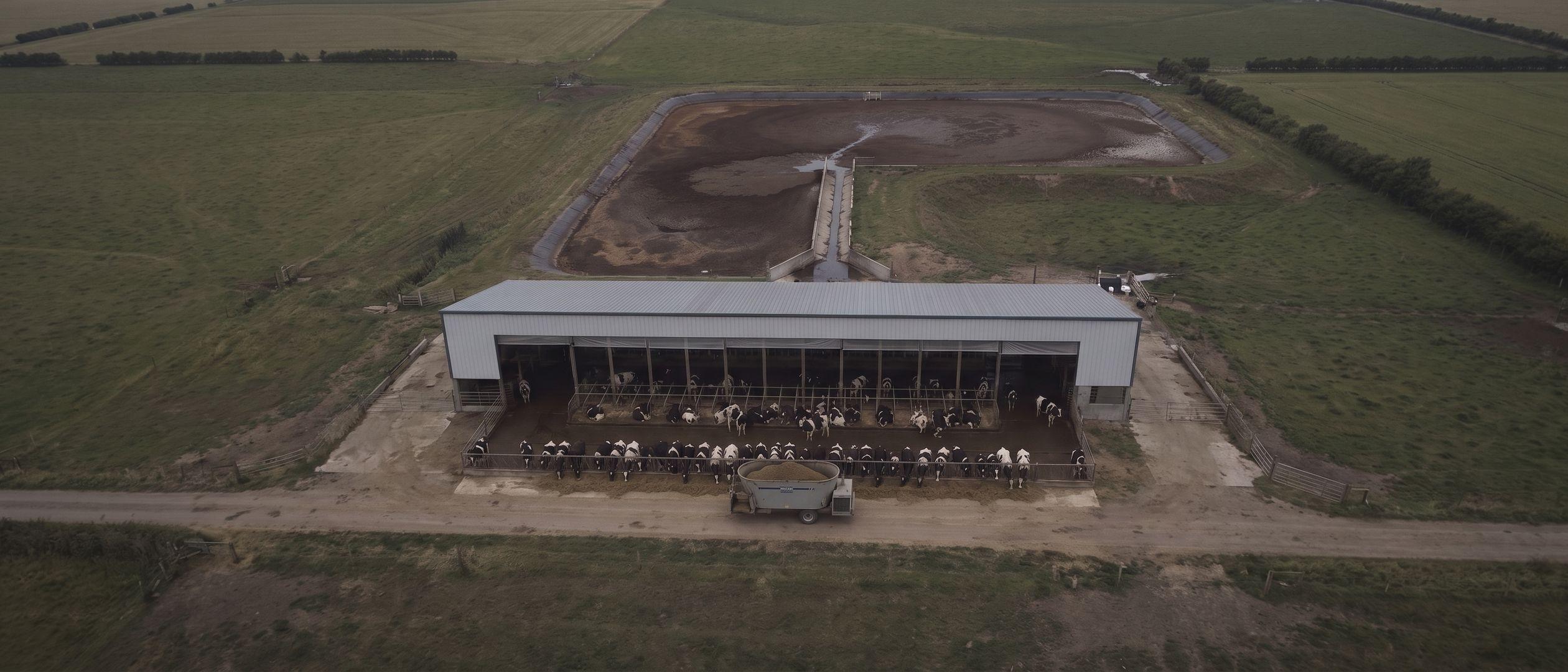
At a glance
| Structures treated | Lagoons, storage pits, flush and scrape systems |
|---|---|
| Typical starting rate | ~1 gallon per month per 75 animals |
| Lagoons | Adjusted for manure already stored plus monthly additions |
| Most common driver | Crust, fly pressure, and lost storage capacity |
| First thing to move | Odor, often within the first week |
| Results | A difference in month one; significant results measured at about six months |
How much treatment does a dairy need?
A standard monthly treatment rate is about one gallon per 75 animals.
Lagoon treatment rates may be adjusted based on the amount of manure already in the lagoon and the amount expected to be added each month. If treatment begins after several months of loading, we may recommend a higher initial rate before moving to the standard monthly treatment.
The treatment plan should fit the operation, the manure system, and the amount of material already in storage.
Why does a dairy lagoon crust over?
Cellulose fiber, arriving continuously. A dairy ration is forage first, and forage is fiber. Add bedding, whether that is straw, sawdust, shavings, or recycled manure solids, and the fiber load entering the lagoon is high every single day rather than in seasonal batches.
The bacterial population that would digest that fiber is the part of the system nobody manages. When it cannot keep up, the fiber does one of two things. The light fraction floats and mats into a crust that dries on top. The heavy fraction sinks and compacts into a layer that behaves less like liquid and more like soil.
Both are the same failure. The crust seals gas underneath and occupies freeboard you need. The settled layer takes volume you built and paid for. Neither is a surface problem, so neither is fixed by anything that only treats the surface.

What does a crusted lagoon cost through the summer?
A crust is a fly nursery. It is warm, moist, organic, and it sits undisturbed for weeks, which is close to ideal for the species that breed in manure. Spray programs kill adults. A crusted lagoon manufactures new ones faster than an adulticide keeps up with, which is why an operation can spray all summer and still have flies all summer.
It is also where neighbor complaints come from. Odor off a stalled lagoon is the smell of incomplete digestion, and it is worst in exactly the still warm conditions when people are outside. Dairies are frequently closer to housing than feedlots are, so the complaint threshold is lower and the consequences arrive faster.
Removing the breeding surface is a different move from killing what breeds on it. That is what treatment does, by digesting the fiber mat rather than by knocking down adults.
How does treatment change storage and pumping?
Settled solids are why agitation takes as long as it does. Compacted material does not go into suspension easily, so the agitator runs longer, burns more fuel, and puts abrasive solids through pumps before the load is pumpable at all.
As treatment helps break that material down it suspends more easily during agitation, the structure comes up cleaner at pump-out, and volume that was under sludge is usable again. For a dairy being pushed into pump-out timing by a shrinking lagoon rather than by field conditions, recovered capacity is the difference between hauling when it suits the crop and hauling when the lagoon says so.
Bring your herd size and lagoon capacity in gallons to the consultation. Rates start from the number of animals and are adjusted for the manure already stored, and the calculator on this site will get you an estimate before you call.
What is treated dairy manure worth on the field?
More than untreated, and for a specific reason. Much of the nitrogen in raw manure is organic, which a plant cannot take up directly. It has to be mineralized by soil biology first, on a timeline you do not control and partly in a season you did not intend.
Bacterial activity in the lagoon converts organic nitrogen into ammonium nitrogen, which plants take up directly. More of the nitrogen you already bought as feed reaches the crop in the year you applied it.
Uniformity matters as much as chemistry. A stratified lagoon does not pump what the analysis says it contains, because the analysis and the load come from different layers. A digesting lagoon is more uniform, so what you spread is closer to what you tested.
What we would start you on
Sized in the consultation, not off a shelf — but these are the products that usually come up for this kind of operation.
LTC-E
Liquid treatment for higher-fiber manure and crusting, monthly or as an amendment when a crust needs extra help.

Manure Digester
PitCharger's flagship product for monthly manure treatment. Contains up to 51 strains of bacteria.

N-Loc
For maximum odor reduction. Addresses odor-producing compounds in the system rather than masking them.
Dairy: common questions
Does it work on a flush system?
The reception pit, the storage lagoon, and any settling structure are all places where solids accumulate and where treatment applies. Flush water itself moves too quickly to be treated in transit. Sizing follows the volume being stored rather than the volume being moved, so the consultation starts with your storage rather than your flush rate.
Will it hold up over a Midwest winter?
Bacterial activity slows as temperature drops, so an outdoor earthen lagoon works more slowly in winter than in summer. Covered and below-grade structures hold heat better and are less affected. Climate and structure are both part of how we set rates and expectations, which is one reason the program is sized on a call rather than from a chart.
Is it safe around the herd and in the parlor?
PitCharger products are described as safe around cattle, horses, pets, children, and vegetation. It is a manure treatment, so it goes into pits, reception structures, and lagoons rather than into parlor sanitation, which is a different job with different chemistry.
How long before anything changes?
Odor generally moves first, often within the first week, and some producers have noticed a substantial change within the first 24 hours. Most producers should notice a difference within the first month, with continued improvement through the second and third months. Significant overall results are normally measured after about six months.
How much does a dairy need?
A standard monthly treatment rate is about one gallon per 75 animals. Lagoon rates may be adjusted based on the manure already in the lagoon and the amount expected to be added each month, and if treatment begins after several months of loading we may recommend a higher initial rate. Bring your herd size and storage capacity in gallons to the call.
Where we work
PitCharger ships from Elkhorn, Nebraska. Since 1998, PitCharger products have been used by producers in 45 states, Puerto Rico, and three countries. PitCharger ships by UPS, Spee-Dee Delivery, and LTL freight, depending on the size and destination of the order. Auto-Ship is available for customers who want scheduled monthly delivery.
Related
Products
- LTC-E: Liquid treatment for higher-fiber manure and crusting, monthly or as an amendment when a crust needs extra help
- Manure Digester: PitCharger's flagship product for monthly manure treatment. Contains up to 51 strains of bacteria
- N-Loc: For maximum odor reduction. Addresses odor-producing compounds in the system rather than masking them